
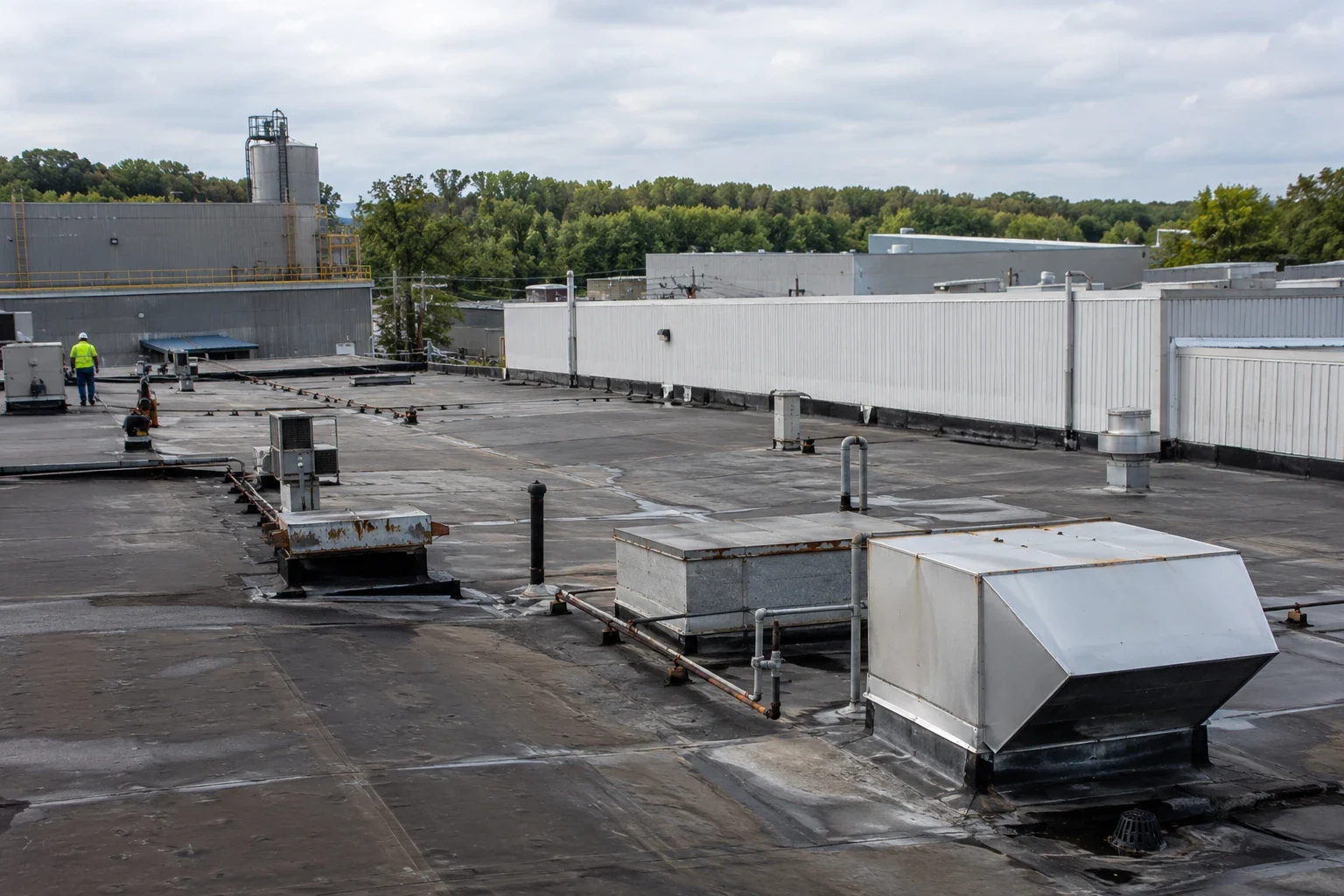
Production equipment can make a roof opening a plant-schedule decision, not only a roofing detail. We start by locating the affected section, identifying equipment and utility penetrations, and confirming who controls roof access. Grand Prairie includes warehouse, distribution, and manufacturing uses, with industrial activity in parts of the SH-161 Corridor. The Great Southwest Industrial District is a broad city district, not evidence of a particular plant's roof construction. We inspect the actual assembly and write the repair boundary around the building's operating conditions.
Equipment map: mark every roof interface
We walk the roof section and map curbs, pipe supports, exhausts, conduits, and penetrations before selecting a repair material. A loose flashing termination can admit water, while movement at a support may require coordination with the trade that installed the equipment. We note which items can be checked from the roof and which require an operations contact or shutdown window. That map gives the plant team a clear list of interfaces involved in the work.
The city identifies industrial and warehouse-distribution land uses within parts of the SH-161 Corridor study area, alongside other land uses. That context supports careful site-by-site planning, not an assumption that every property there is a plant. For a confirmed building, a curb and equipment-support repair can isolate the flashing or attachment detail without making a broad roof-system claim.
Production window: define the operating boundary
Before staging material, we confirm production hours, truck paths, exhaust conditions, restricted areas, and the contact who can authorize access. If a repair requires work near an intake, process exhaust, or sensitive production zone, the plan identifies how the roof activity will be separated and when the equipment owner must be present. We do not assume a shutdown is available. The scope states the required access window and the steps that depend on it.
Grand Prairie's city description connects highway, rail, and airport access with warehouse, distribution, and manufacturing construction. Those uses make loading and equipment coordination relevant to the market, but the building's own operations establish the work sequence. An industrial logistics operator may run a different shift pattern than a manufacturer, while a property management team may control multiple tenant notices. We confirm the actual contact and access rules before mobilizing.
Assembly check: know what supports the repair
A roof section can include membrane, insulation, cover board, attachment, deck, and several generations of repair. We review project records, then verify visible details in the field. A coating or patch should not hide wet insulation, unstable substrate, or a failed transition. If the repair boundary reaches a curb or wall, we document how the new flashing ties into the existing assembly and what other trade work must be completed before the roof is closed.
On a metal building, structural information can affect new openings or equipment changes. If a proposed plant building uses metal framing, Grand Prairie's plan review expects an engineer's seal on structural documents at any floor area. The current permit scope and governing requirements still need confirmation for the project. When insulation or cover board is part of a roof replacement, the insulation and cover-board scope should identify thickness, attachment, substrate, and edge transitions rather than hide them in a general roofing allowance.
Heat and weather: schedule from conditions, not assumptions
DFW summer heat changes safe roof access and can affect the handling window for some materials. For a plant roof, separate the hot-day benchmark from the monthly averages: Grand Prairie averages 20.2 days per year at or above 100°F, while August's normal high is 95.8°F after July's 95.6°F. We use those normals as scheduling context, then plan against the actual forecast, site conditions, and manufacturer installation requirements. A crew should not leave an assembly exposed because a production window ran longer than expected.
Spring is the area's peak season for thunderstorms and severe weather, but regional hazards do not establish damage at a specific facility. We inspect after a reported event, photograph the observed condition, and separate storm-related evidence from routine wear or prior repairs. A maintenance sequence can keep drains and penetrations on a planned review cycle. For a metal system, standing-seam roof service follows the actual panel and attachment details rather than treating all metal roofs alike.
Work phase: protect the line while the roof is open
We divide the scope into roof sections that can be protected, repaired, and closed within the approved access period. The sequence identifies material delivery, lift locations, debris routes, temporary dry-in, and any step that needs a production contact. If two trades share a curb or penetration, we establish who completes each interface before the roof crew closes it. Those details help a general contractor coordinate work without leaving the plant team to reconcile separate scopes. A daily handoff can list the roof area released, the equipment interface still open, and the next contact who must approve access. That note helps operations restart the right area without treating an incomplete roof phase as finished.
A phased occupied-facility reroof plan can keep the open area limited and show the next handoff. We mark the area that is complete and the section still awaiting access, testing, or trade work. If a field change becomes necessary, it is recorded against that location before the crew moves on. The operating team can then confirm that equipment and production routes are ready for the next phase.
Closeout: tie repair records to production assets
The closeout record identifies the roof section, work performed, photographs, materials when documented, and any item that remains open. We label equipment interfaces clearly so later service work does not confuse a new curb with an older roof patch. A follow-up record should name the tested roof section and what the water check showed, so plant staff can see which transition was cleared. That gives plant maintenance and facilities teams one usable history for the next roof call.
A condition report can also distinguish a verified repair from a recommendation that needs access or testing. We keep the notes plain enough for the operations contact and detailed enough for the capital reviewer. A property owner can compare current repairs with future replacement needs without treating the roof as a single uninterrupted surface. The same record gives the contractor a defined starting point when equipment or production changes require another roof review.
Commercial Roofing Questions
What should be mapped around rooftop production equipment?
We mark each curb, support, penetration, and nearby seam, then identify whether another trade controls the equipment. The map should show the roof section and access limit so a flashing repair does not proceed before the interface is ready.
How do you schedule repair work near active production?
The plant contact confirms operating hours, restricted routes, intake or exhaust constraints, and the approved access window. We sequence staging, roof opening, temporary protection, and closeout around those rules instead of assuming an equipment shutdown is available.
When does an equipment curb need a wider roof review?
A wider check is warranted when the curb movement, wet insulation, failed attachment, or recurring water path extends beyond the visible flashing. We test the area and state which condition changes the repair boundary before adding scope.
What does a good phased roof scope show to plant operations?
It names the section open each shift, the temporary dry-in, material and debris path, trade handoff, and area ready for return. We record any access constraint that could move work into another production window.
Which records help after a rooftop equipment change?
Keep the equipment location, curb detail, roof material, photographs, and contractor closeout together. We note which flashing or support was worked and whether a follow-up inspection is needed after the equipment trade completes its task.
Map the roof section around production
Send the affected building and roof area, equipment list or curb locations, active leak status, available assembly records, and an approved access window. We can document the interface and sequence the next repair step.
Call 555-555-5555 or request a roof assessment.