
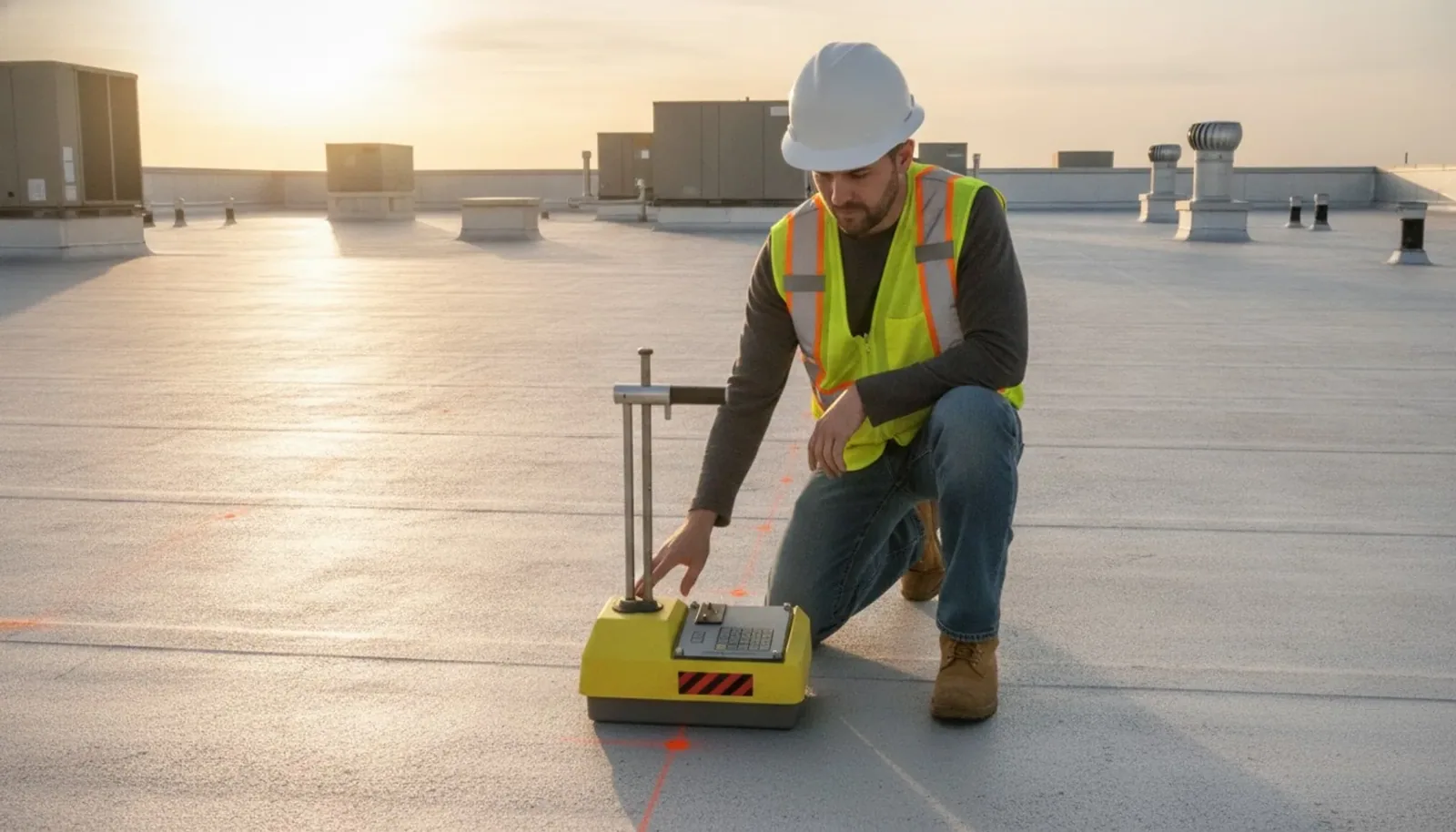
A warm or cool pattern on a roof is a place to investigate, not a moisture result by itself. We use infrared imaging to screen for areas that may warrant direct verification, then compare those patterns with seams, drains, curbs, and reported leaks. In Grand Prairie, a large distribution roof in the Great Southwest Industrial District may need a different survey route from a corporate building near I-20. The assembly, weather, and timing affect what an image can show. A useful survey labels the pattern, verifies selected points, and maps the boundary that changes the repair decision.
Choose the question before imaging
We start with the reason for testing: recurring leaks, a planned recover, a replacement estimate, or a roof area that cannot be judged visually. The survey plan records the roof system where known, the last repair locations, available building records, and the roof sections to compare. Infrared equipment detects surface temperature differences under suitable conditions. Those differences can result from moisture, but also from insulation, deck changes, shade, equipment, or changing heat release. The survey identifies candidates for verification rather than declaring each pattern wet.
The Great Southwest Industrial District is a major warehouse and distribution area, and the Central Business District is a separate setting. A broader roof may make section labels and access routes especially useful. We mark drains, curbs, rooftop units, parapets, and areas with known repairs so the image can be interpreted against the building layout. A hands-on roof inspection adds the close view needed at seams and transitions, while overhead imaging can help organize broad surfaces before selected locations are tested.
Record the conditions around the scan
Survey timing matters because a roof surface responds to sun, wind, cloud cover, and the materials below it. We record conditions that affect the image and note where a pattern may be influenced by shade, equipment, or a change in assembly. The roof should be reviewed using an appropriate method for its system and access. A scan taken under unsuitable conditions may leave an area inconclusive, which is a reason to adjust the test rather than stretch the interpretation.
DFW summer normals show high temperatures and recurring days above 100 degrees. That regional context informs scheduling and material handling, while the survey still depends on the actual roof and the imaging window. We compare adjacent roof sections with similar exposure where possible. A pattern that crosses a known insulation change may not mean the same thing as one around a leak report. The field record explains where the image is useful and where a core cut or other direct test is needed.
Verify the locations that change scope
After screening, we select locations where a test result would alter the repair boundary. A core cut can identify the layers at that point and show whether insulation is wet or dry. We photograph and label the opening, record the material observed, and restore the roof detail after testing. The owner can see which image patterns were confirmed and which remain only candidates. This distinction prevents a temperature map from being used as a blanket measurement of every roof section.
If the survey finds a contained wet area around a drain, the scope can identify its extent and the repair needed to restore the water path. If several sections show confirmed moisture or failed attachment, the replacement boundary may be broader. A recover decision depends on whether the existing assembly can remain, while replacement planning addresses removal and substrate repair when required. Both choices need verified conditions, not color patterns alone.
Connect test points to drainage and details
Moisture does not always collect directly below its entry point. We compare candidate areas with seams, penetrations, wall transitions, sumps, and outlets, then look for a plausible water route. A drain bowl may be clear while the surrounding membrane or clamping detail is weak. A curb can direct water under a flashing if its corners or termination have opened. The survey map marks these relationships so a verification point answers a roof question instead of creating an isolated dot on a drawing.
The city calls the I-20 Corridor a developing retail and corporate location. Those property types may have different roof layouts, but the test logic remains the same: identify the section, inspect the nearby details, and confirm moisture where it affects a decision. Drain and scupper repairs can be included when an outlet detail is part of the pathway. We record any area that could not be tested or where roof access limited the survey.
Turn results into a bounded scope
The final report separates screened patterns from verified wet material and from visible defects. It maps each confirmation, lists the test method, and explains how the finding changes the repair or replacement boundary. Cost depends on the area to remove, substrate condition, membrane compatibility, access, and whether equipment or other trades must be moved. We can price alternate boundaries when one unresolved location changes the amount of removal, so an owner can compare options using the same assumptions.
Spring storms are common across the DFW region, but a regional hail or wind report does not prove that a specific roof has moisture. The imaging record is tied to the property’s own conditions and test results. A survey after a leak or storm may show areas that need follow-up, but the repair recommendation still depends on what direct inspection confirms. Ponding-water conditions are evaluated through drainage and membrane observations as well as any moisture testing.
Keep the map useful after testing
A useful closeout contains a labeled roof plan, image set, condition notes, verification locations, photographs of test openings, and the restored details. It names areas that were confirmed, inconclusive, or not accessible. The owner can share the same map with a general contractor, facility team, or estimator and see how the proposed scope follows the evidence. We note any limitations so a future reviewer does not mistake a screening pattern for a tested moisture boundary.
The map can support a later inspection or capital review by preserving where repair work occurred and which points need monitoring. A roof condition report can combine those findings with other roof observations and priorities. For commercial roofs in Grand Prairie, the survey remains specific to the actual assembly, drainage route, and operating schedule. Share the leak history, known system, roof sections, and access window to plan the first scan.
Commercial Roofing Questions
Does an infrared scan measure moisture directly?
No. The camera records surface temperature differences. Those patterns can identify locations for further investigation, but direct verification is needed before moisture is confirmed or used to set a removal boundary.
When should a core cut follow the scan?
A core cut is useful where the result would change the repair, recover, or replacement decision. We select and label verification points, record the layers and condition found, and restore the opening after testing.
Can equipment or shade affect the infrared image?
Yes. Shade, rooftop equipment, insulation changes, deck conditions, and weather can influence temperature patterns. We record those factors and avoid treating every warm or cool area as wet material.
Will the survey show the exact leak entry point?
Not by itself. The survey helps locate candidate areas. We compare them with reported leaks and inspect seams, curbs, drains, and transitions to trace a supported water path before recommending repair.
What should the owner receive after testing?
The report should include labeled images, a roof map, verified test results, photos of opened and restored points, and areas that remain uncertain or inaccessible. Those records show how the recommended scope follows the evidence.
Map the areas that need verification
Share the roof area, leak history, known assembly, and the decision the survey needs to support. We can plan the scan, choose verification points, and document the repair boundary that follows.
Call 555-555-5555 or request a roof assessment.