
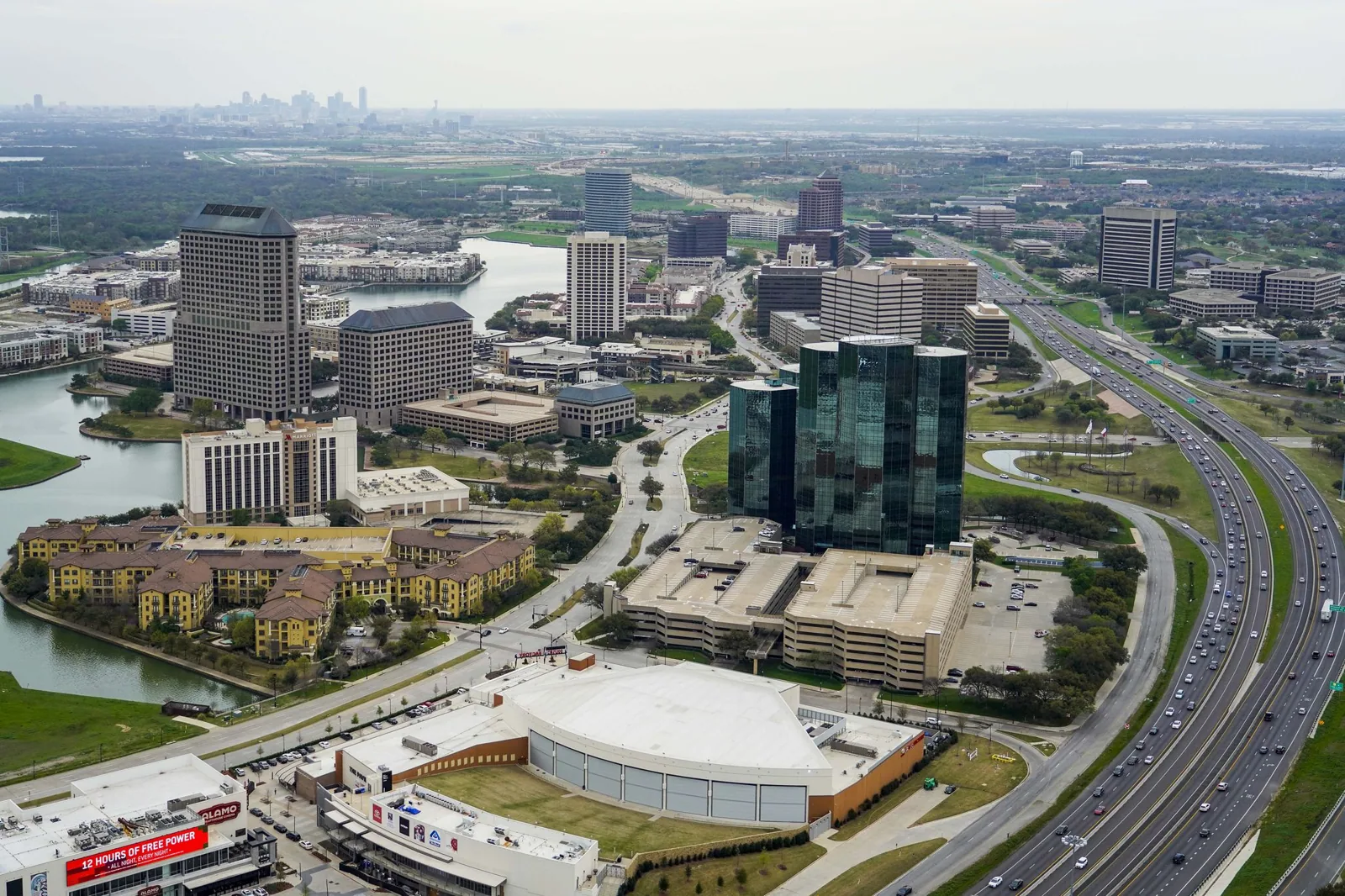
Rooftop equipment sets the repair plan on most Irving roofs before the membrane does. Every curb, pipe boot and condenser stand is a place where a sheet has been cut and sealed by hand, and each one has its own failure pattern. Irving sits about 12 straight-line miles north of Grand Prairie, close enough that a first walk and a follow-up check fit in the same week. Irving's 2022 numbers show a logistics and warehousing base worth billions of dollars and a retail base nearly three times that size, so we expect low-slope roofs with plenty of penetrations. We map those details first, then decide what the field of the roof needs.
That order matters because water follows the path of least resistance. A roof with eight penetrations and one marginal drain will show a leak at a different place after every storm until the contributing details are corrected together.
Curb transition: where equipment meets the membrane
A curb transition fails slowly. Sealant dries, the flashing pulls away from the curb face, and water finds the gap along a corner or a counterflashing joint. We look at each curb for cracked sealant, lifted base flashing, open laps and standing water at the upstream side.
Equipment that has been moved or replaced over the years often leaves abandoned penetrations behind. Those are cheap to cap and expensive to ignore. When a unit needs new curbs and supports, we coordinate with the mechanical trade so the new curb is flashed into the membrane before the unit is set, not afterward by someone working around it.
We also check whether the supports let water pass beneath them or dam it up, because a pipe stand sitting across a drainage route creates a pond that no flashing can outlast.
On the first walk we also mark the spots where service technicians have been walking, since repeated foot traffic between units wears a path in the membrane. A walk pad costs little and protects the sheet where a technician steps most often.
Heat exposure: what long summers do to a seam
For an Irving roof visit, reserve heat-sensitive details for a suitable work window; roughly twenty annual days hit 100 degrees, and summer monthly highs approach 96. The figures describe the region and say nothing about a particular roof, yet they explain why dark membranes expand and contract hard against their fasteners and flashings through summer afternoons.
We look for shrinkage at corners, chalking on the surface, and hardened sealants. Where the membrane still has life, a heat and UV damage repair can reseal vulnerable details. Where the surface is sound but weathered, a coating can slow further wear, and a cool roof surface lowers the temperature the membrane sees.
Seam condition is the clearest sign of heat stress. A heat-welded seam that has opened shows a clean edge, while a seam that was only sealed will show a gap where the sealant has shrunk. We probe seams with a rounded tool and record each opening by roof section, so the repair can be limited to the seams that need it.
Logistics roofs: loading zones and phased access
The City of Grand Prairie describes its own distribution economy as drawing on interstate, rail and airport access, and Irving's own transportation figures point to logistics activity of a similar kind. For a roofer, a distribution building means active dock doors, truck courts and tight delivery windows underneath the work.
We separate the roof work zone from the ground traffic, plan the hoisting area away from dock doors, and divide the roof into phases that match the operator's calendar. On a large distribution center roof, this lets the building keep shipping while one section is opened, repaired and closed.
A building with rooftop dock canopies, truck-court drains or rail-side loading adds more details. We confirm who controls roof access, whether a permit-to-work system applies and how the safety team wants fall protection set up before the first ladder goes up.
Retail and office roofs: smaller sections, more details
Store and office roofs are often divided into several roof levels, with parapets, scuppers and many penetrations. Their problems differ from a warehouse: more flashing, more drain lines and more tenants with different roof-leak tolerance.
For a shopping center or an office building, we ask which tenants sit below which sections, who holds the roof lease obligations, and when noise is acceptable. That tells us how to order the repairs and who needs notice before the crew arrives.
Drains on these roofs are often shared among several tenants, so one blocked line can flood a section above a neighbor. We clear and test each drain on the first visit and describe the path water takes if a primary drain is blocked.
Repair boundary: where a patch should stop
A repair should end where sound roof begins. We test the area around a defect with a probe, a moisture reading or a water test, then draw the boundary beyond the last bad point. Patches that stop short tend to leak at their own edges within a season.
If the repair boundary starts to cover half of a roof section, the conversation changes to a restoration coating or a section replacement. We lay out both with their expected service life, the surface preparation they need, and the points at which a coating would not suit the substrate.
A good boundary also protects the budget. Owners see exactly what a patch covers, why the line was drawn there and what would trigger the next step, so a repair is neither padded nor left half done.
Closeout record: documents that travel with the building
At the end of each job we leave a record the owner can file: roof sections, details repaired, photographs and flagged items. In a portfolio that includes buildings in Coppell and the Great Southwest Industrial District, the same layout makes it easy to compare roofs and plan spending across them.
The record also helps insurers and lenders understand the roof's condition without a separate visit, and it gives the next contractor a head start if ownership changes.
When the record shows the same seam or curb failing twice, that pattern becomes the next scope item, with a recommendation based on the earlier photographs instead of a new guess.
Commercial Roofing Questions
Why do Irving roofs leak around equipment after a replacement?
New membrane is often cut around existing curbs without rebuilding their flashing. When old sealant or fasteners remain, water finds them within a season. Specifying curb flashing as its own line item, with the mechanical trade coordinated, prevents a repeat of the same leak.
Does a coating make sense on a heat-aged roof in Irving?
Sometimes. A coating needs a clean, dry, well-adhered surface and insulation that is not saturated. We test adhesion and moisture first. If those pass, a coating can extend service life and reduce surface temperature. If they fail, repair or replacement is the better route.
How are noisy roof tasks scheduled over an occupied office?
We ask when meetings, calls and deliveries are least affected, then place tear-off and fastener work in those hours. Quieter tasks like sealing and inspection can run any time. The plan is shared with the property manager before the first day.
Who decides whether an old roof can be recovered instead of removed?
The existing roof's condition decides. A recover needs dry insulation, a flat enough surface and a deck that can hold the added weight. We cut test cores and read moisture before offering a recover as an option, and we state the building code limits on layers.
What does a repair record look like for an Irving property file?
It lists each roof section, the defect found, the correction made and photographs taken before and after. Open items are flagged with a recommended timeframe. Managers attach it to the building file so the next walk can start from this baseline.
Send the equipment list
Share the leak location, the number of rooftop units, the roof material if known, and the access window. We will walk the roof, trace the water path, and document the next scope decision.
Call 555-555-5555 or request a roof assessment.