
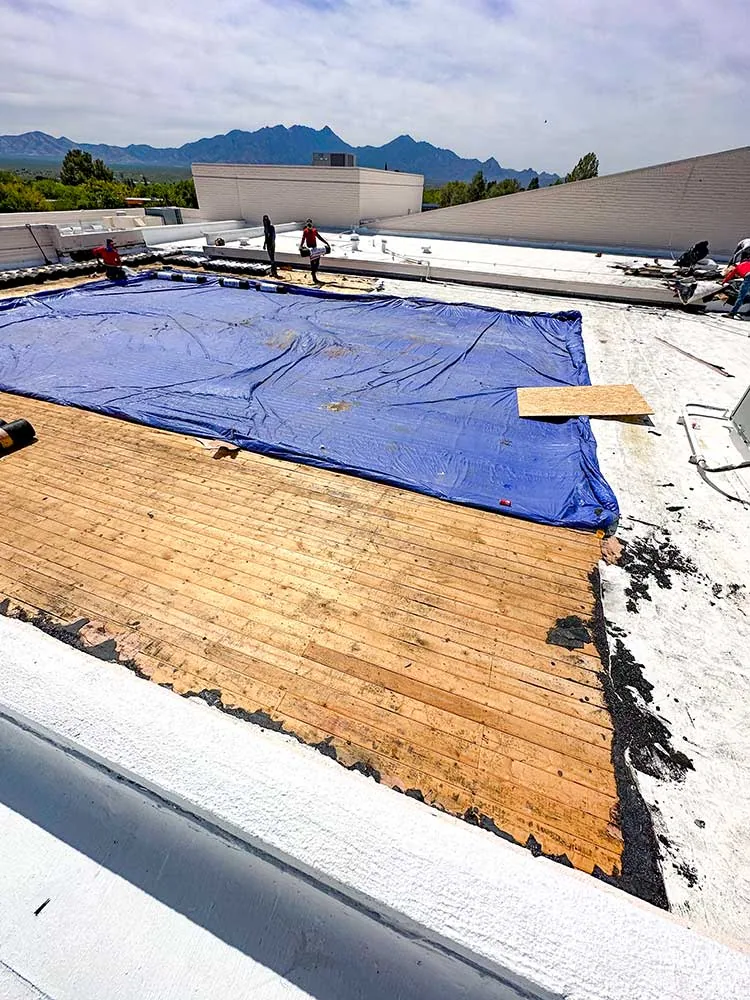
A puncture may leave a small mark on the membrane and a much larger wet area below. We protect an active opening first, then identify what made contact, how far water may have traveled, and whether the insulation or deck is affected. On roofs serving the Great Southwest Industrial District, mechanical service and material movement can bring foot traffic to equipment zones; we inspect the actual route instead of guessing at cause.
First check: isolate the opening
The crew photographs the puncture with a scale, notes membrane type, and marks the closest seam, curb, drain, and roof access path. A temporary cover can limit additional entry when permanent repair must wait for safe access or dry conditions. We ask the facility contact about recent maintenance, dropped tools, loose fasteners, or debris, then keep those observations distinct from a confirmed cause. That record helps protect the roof and avoids assigning responsibility before the evidence is reviewed.
A cut, puncture, abrasion, or fastener hole can require different patch geometry. We inspect the membrane around the mark for stretch, contamination, cracking, or a second impact point. If the surface is clean and dry, the repair may be limited to a compatible patch. If water has entered the assembly, removal may need to extend until dry, sound material is reached. The hail damage check is separate when there are multiple impact marks.
A service-created hole may sit beside a fan, pipe support, or walkway rather than at a roof edge. The building contact can identify recent mechanical visits, but the field review checks the contact point, nearby fasteners, and any protective mat or walkway. We record whether the mark is a cut, impact, abrasion, or displaced attachment. That distinction changes patch preparation and helps management correct a recurring traffic exposure without assigning a cause the evidence does not show.
Assembly check: look below the membrane
The roof record identifies membrane, insulation, cover board, deck, and attachment. An approved test opening can show whether the puncture reached insulation or deck, but one sample does not represent the whole zone. We take moisture readings where appropriate, mark test locations, and document the repair of each opening. If the membrane is adhered, mechanically attached, or part of a recover, the patch edge and tie-in must work with the existing layer rather than trap an unresolved wet area.
Grand Prairie is a distribution center, and the Great Southwest district sits apart from the I-20 and I-30 corridors. Those broad references can help orient a service visit; they do not reveal the condition of an individual roof. The site contact identifies freight lanes, rooftop service routes, and any staging limits. For a curb puncture, the crew records whether mechanical equipment can be shut down and whether the curb support scope involves another trade.
Water path: map moisture beyond the mark
We trace the roof slope from the opening toward drains, scuppers, laps, and low areas. Inside, staining or a drip location is recorded but not assumed to sit directly under the puncture. Water can move along the deck or within insulation. A moisture map helps estimate removal if the owner approves testing. The report separates the visible hole, the measured wet area, and any concealed area that could not be reached during the first visit.
DFW’s wetter spring and fall transition periods provide a useful time to check drainage after storms, but they do not prove a property flooded. We examine the nearest outlet and note whether water remains on the roof after surrounding sections dry. If a low area is implicated, a ponding water review can assess the plane. A drainage inspection can address blocked outlets separately from the membrane patch.
The patch layout extends onto clean, compatible membrane beyond the damaged edge. Rounded corners help avoid a new stress point, and the perimeter receives a final check after the selected weld, adhesive, or cure process. Where removal exposes wet insulation, we photograph the layers and stop at the approved quantity until the owner reviews an added scope. The closeout note separates completed surface repair from any remaining moisture investigation, so an interior follow-up has a clear next location.
Patch design: match the repair to the membrane
For a thermoplastic sheet, the crew cleans the surrounding membrane, checks weldability, makes a test weld, and installs a rounded patch with adequate sound material around the opening. Other systems use their own primers, adhesives, or repair components. The proposal names material, patch limits, preparation, and whether wet insulation is included. A sealant smear is not a replacement for an approved patch detail, and coating over the hole does not address a damaged substrate.
The owner can compare a spot repair with a wider recover or replacement if punctures repeat or the assembly is near the end of serviceable condition. The decision should include membrane condition, number of openings, moisture, attachment, and how future trades will reach rooftop units. A TPO repair detail applies only when that system is present. A broad seam failure assessment is useful if openings are accompanied by joint separation.
Access sequence: control traffic and repair
Before work, the manager identifies the hatch, ladders, escort rules, rooftop equipment paths, and service contractors. We mark the repair zone and protect nearby drains from debris. The crew completes the patch, checks the perimeter, and photographs the finished tie-in. If the puncture was near a service path, the closeout can show a temporary protection method or an agreed walkway change. The owner can coordinate that follow-up with maintenance staff rather than rely on memory.
Grand Prairie’s commercial permit page identifies code and plan information to verify when work extends beyond a membrane repair into structural changes. A localized patch normally stays a roofing task, but the project team confirms scope if deck or framing damage is uncovered. The estimate says what is included and who approves added work. When an opening is actively admitting water after hours, emergency roof response can provide temporary protection before the permanent repair window.
Closeout record: label the hole and patch
The report records the puncture location, dimensions, system identification, patch materials, test or moisture findings, and photos before and after repair. It identifies any wet material removed and any zone that remains untested. The owner receives a roof map that can be used when a mechanical contractor returns, reducing the risk of a repeated foot-traffic path through the same area. The recommended next check is tied to the condition found, not a generic calendar.
Grand Prairie’s I-20 and SH-161 corridors include different commercial settings, and the Central Business District is mapped separately. The service plan uses those broad places only for orientation. Property-specific access, roof layout, and maintenance activity determine the repair sequence. Share any service records, interior observations, and approval limits so the next scope includes the right test area and closeout details.
Commercial Roofing Questions
Can a small puncture wet a large area?
It can. Water may travel through insulation or along the deck before appearing indoors. We map the opening and measure surrounding conditions before pricing removal.
Can the roofing crew patch over a wet spot?
The scope should identify whether wet material must be removed. We document readings or approved test openings and close the roof only after the patch detail is ready.
Is sealant enough for a puncture?
The membrane system and opening determine the repair. We use a compatible patch detail and record its limits rather than relying on a surface smear.
How can later trades avoid another hole?
The closeout map can mark the repair and service path. The owner can coordinate a walkway or equipment route with maintenance and mechanical contractors.
Will the repair include insulation replacement?
Only if the approved scope includes removal. We identify measured or exposed wet material and request direction before extending beyond the authorized boundary.
Document a membrane puncture
Send the roof zone, reported opening, membrane records, and access limits. We can protect an active opening, measure the affected area, and price a compatible patch.
Call 555-555-5555 or request a roof assessment.