
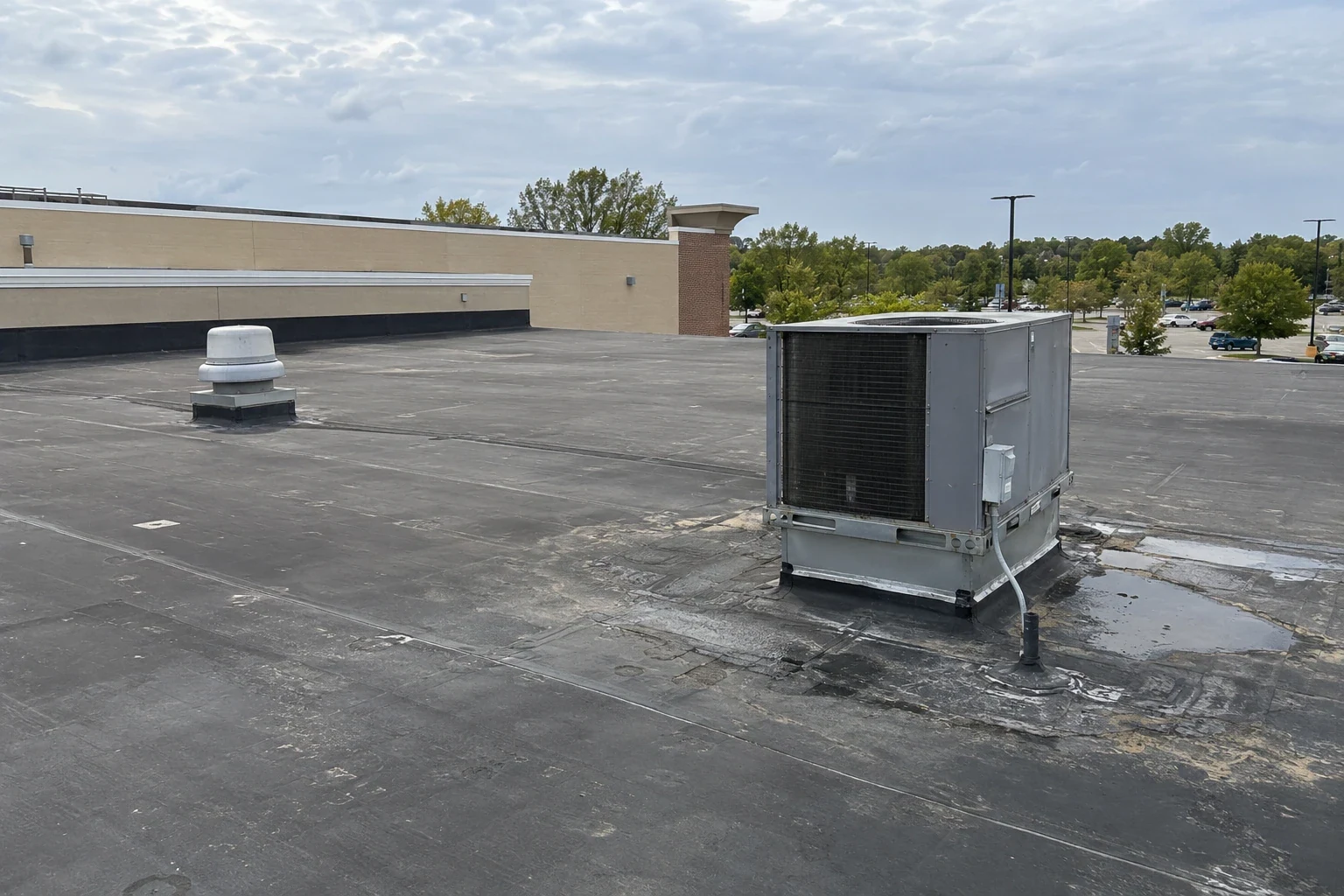
A water report near refrigerated cases or receiving doors needs a roof-side check before the store changes equipment or closes an aisle. We map the affected section, note the water path, and identify access and delivery constraints before choosing a repair boundary. Grand Prairie has a large retail and food-service base, and I-20 and I-30 are distinct commercial corridors. That describes broad local activity, not a particular grocery roof. The building’s assembly, refrigeration equipment, drainage, and operating schedule control the work sequence.
First check: map cases, receiving and roof zone
The store contact identifies the reported room or aisle, receiving window, refrigeration service route, and any food-safety or sanitation control that affects access. We map drains, seams, curbs, penetrations, and previous patches directly above the authorized area. A ceiling mark or condensation report is not enough to locate a roof opening; we compare the interior information with membrane details and nearby water routes. We mark zones needing a test opening separately from conditions that are visible.
The I-20 corridor and I-30’s business and entertainment corridor are different commercial settings. Neither shows what one store contains or how its roof is built. We verify that with the manager and field survey. A commercial roof inspection can set the first map and preserve the access windows required by receiving operations.
Assembly: coordinate refrigeration interfaces
Refrigeration equipment, exhaust, electrical conduit, and rooftop supports create penetrations that need compatible flashing and planned service access. We compare drawings and repair records with visible membrane, attachment, insulation, deck, curbs, and perimeter metal. Additions can leave different layers on one roof. Test openings require owner approval and are documented with their exact section and closure detail. If moisture extends beyond the visible defect, the report identifies the area that needs evaluation before a cover layer is priced.
A small curb or seam issue may support commercial roof repair. Widespread moisture or recurring failures call for comparing a recover with replacement. TPO and EPDM use different seam and flashing methods. The current assembly, refrigeration service plan, specifications, and warranty requirements inform the system decision.
Drainage: check the outlets near the work zone
We trace water from roof slope to drain bowls, sumps, scuppers, and overflows, then photograph the route and each membrane termination. Debris may call for cleaning; a loose flange or damaged flashing needs a roof repair. Slope correction is a separate design question. The estimate states what was observed and which outlet will be corrected. Store staff handle any interior aisle control while the contractor protects the opened zone and records the work performed.
DFW spring and fall are typically the wettest transition seasons. That context supports periodic drain checks and post-storm observation, not a claim that a specific grocery roof has flooded. Drain and scupper work can be separated from field membrane repair and tied to the roof map. The closeout notes whether the outlet was cleaned, repaired, or left for design review.
Sequence: fit the receiving calendar
The owner and general contractor agree on receiving hours, refrigeration service windows, delivery routes, lift placement, and areas that must stay accessible. We divide the roof into daily sections that can be inspected and dried-in under the planned conditions. Materials and debris use approved routes. If hidden deck damage changes the scope, work stops at the defined boundary while photographs and written direction are prepared. The plan names who can authorize an added cost and who verifies the store is clear at the end of each shift.
A grocery roof crew should check heat at the membrane before opening material; DFW logs 20.2 days at 100°F or more, with July and August highs averaging 95.6°F and 95.8°F. Regional heat informs scheduling and storage, while the workday forecast determines daily protection. A cold-storage roof has controlled-temperature layers; a grocery store adds receiving, food-safety, and customer-path controls. We build the schedule from the property’s operating plan.
Options: distinguish a patch from system work
A repair can address a confirmed flashing or field defect without disturbing sound zones. Recover evaluation requires moisture testing, secure attachment, acceptable layer count and height, and compatible details at refrigeration equipment. Replacement can expose deck conditions and create a new water-control system, but it involves removal, disposal, sequencing, and more extensive interior planning. We compare options with the same roof map and line items for curbs, drains, insulation, edges, equipment coordination, and allowances so the owner can weigh work against store disruption.
The city commercial permit page lists code families and project requirements to confirm with the local building team. Structural or permit review may apply depending on scope. We show those questions rather than assume approval. The I-20 retail and corporate area and I-30 business corridor are broad local references; neither changes the need to verify the store assembly and access plan.
Closeout: record equipment and drainage details
Photos and notes identify completed curb flashing, repaired seams, drains, and any roof sections outside the contract. The owner receives the material record, dates, weather limits, and open recommendations. Refrigeration technicians can use the map to coordinate later equipment changes and prevent unplanned roof penetrations. If a moisture area was not investigated, it remains listed as an open item with the next decision clearly named. The record does not imply a full-roof test when only one zone was inspected.
Business districts and corridors, including I-20 and I-30, sit in different parts of Grand Prairie. A store’s own receiving calendar and roof plan remain the basis for service. Share the section map, reported conditions, equipment records, and access windows when scheduling a visit. We can document the observations and set a next phase for maintenance, repair, investigation, or replacement.
The Great Southwest Industrial District and I-20 Corridor are broad mapped places, not a directory of grocery properties. The store’s own receiving dock, refrigeration service route, and roof hatch determine the daily sequence. We identify whether a price includes curb flashing, drain work, insulation replacement, and interior protection, because those scopes can require separate trades. A written work limit also helps the manager schedule refrigeration technicians without leaving an open roof detail between shifts. The completed section is photographed before access moves to the next area.
Where the assembly includes insulation above a conditioned store, moisture findings need a mapped boundary before new material covers the area. We label the sample location, record the roof layers observed, and distinguish a confirmed wet area from a suspected one. The manager can then coordinate refrigeration service and food-area protection with the roofing phase. An adjacent shopping center or restaurant brings related occupied conditions with its own operating sequence.
Commercial Roofing Questions
Could refrigeration equipment cause a roof leak?
A curb, pipe, or service penetration can be involved, but the inspection checks the flashing, nearby seams, drainage, and assembly before assigning a cause.
Can a store keep receiving during repairs?
Often the work can be staged around delivery hours if site access allows. The manager approves lift locations, material routes, and daily work boundaries.
How do you avoid closing food departments?
The store determines any interior controls. We plan roof zones, dry-in, notices, and emergency contacts with facilities before mobilizing.
When is a recover appropriate?
Only after evaluating moisture, attachment, layer limits, finished height, equipment transitions, and project requirements.
What maintenance record is useful?
A roof map with drain, curb, seam, repair, and open-item locations helps store staff coordinate equipment service and follow-up inspections.
Coordinate the grocery roof scope
Share receiving windows, refrigeration access, reported leak areas, and roof records. We can document the assembly and prepare a phased work plan.
Call 555-555-5555 or request a roof assessment.