
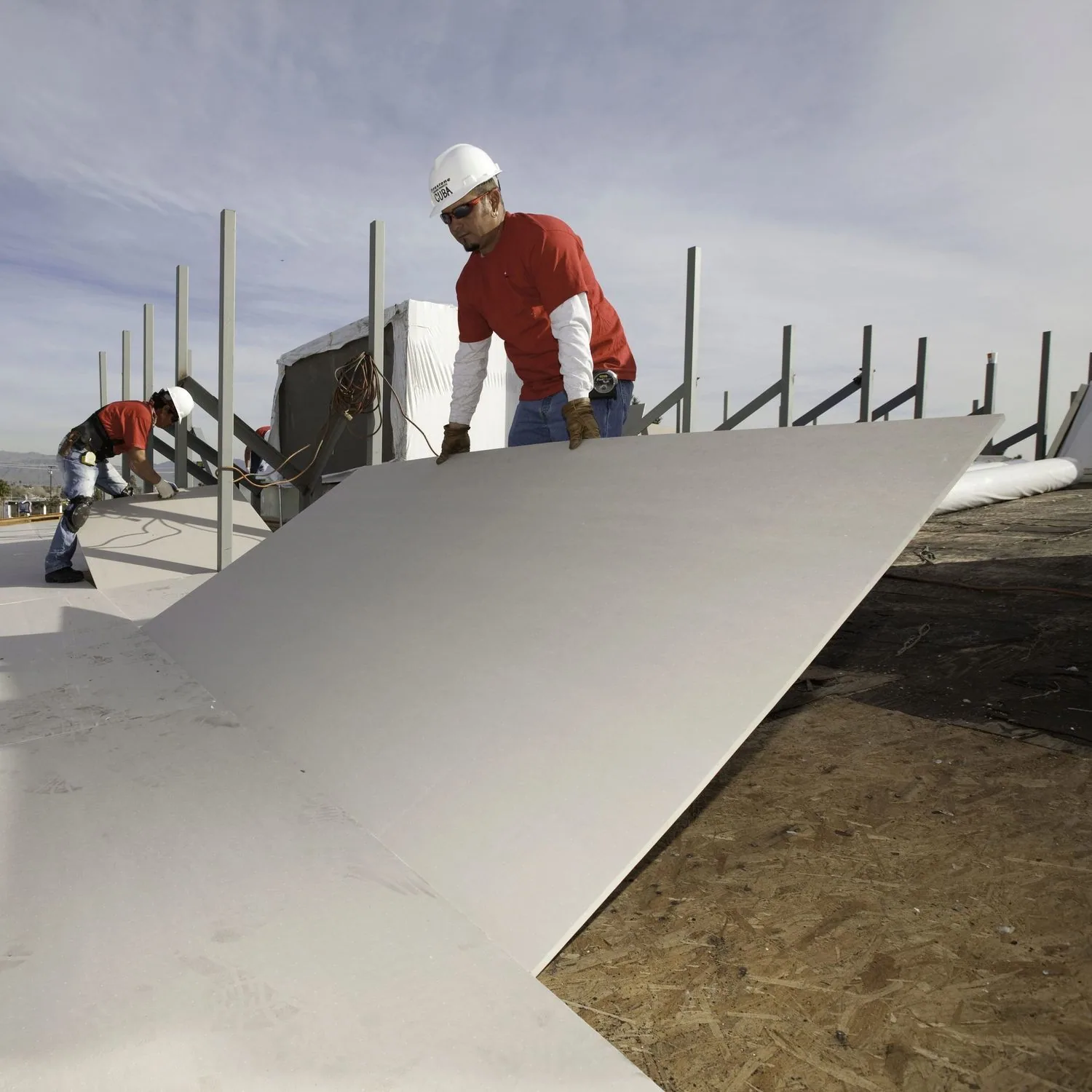
Older roof paperwork often carries the Firestone name, and the same products now sit under Holcim Elevate. That change matters on the roof only in one way: the owner may hold documents that use either name, and we need to match them to what is actually installed. Holcim Elevate, formerly Firestone Building Products, makes UltraPly TPO and RubberGard EPDM among other commercial systems. Our first observation is the membrane in front of us, followed by how it is attached and where the seams and flashings have moved. In Grand Prairie, TX, long hot summers and spring storms put different stresses on those details, so we check them one by one.
First check: matching the paperwork to the roof
A building can carry a single-ply membrane that was installed under the Firestone name and later maintained under a different brand. We compare the owner's files with the sheet itself: thickness, color, surface texture, seam construction and fastener pattern. Labels from leftover rolls or sealant tubes also help.
If the documents and the roof disagree, we trust the roof. An older EPDM roof may have been patched with materials from another maker, and a TPO section may have been added next to it years later. We mark each roof section on a sketch and note its apparent age, because the repair plan differs from one section to the next.
That sketch becomes the working map for every later decision.
Seams and flashings: where the leak usually starts
On a single-ply roof the sheet itself is rarely the first failure. Leaks begin at a splice, a corner, a pipe boot, a curb base or a termination bar that has lost its seal. We trace those details in order, starting at the interior stain and moving toward the highest suspect point on the roof.
Probing a seam is simple. A rounded tool tests the edge of each weld or splice for lift, and we mark every open stretch. For a seam failure, the repair method follows the membrane: heat welding on a thermoplastic sheet, tape or liquid adhesive on rubber. We then confirm the surface is clean and dry before the patch goes on, because a poor bond will fail within a season.
Edge details deserve the same attention. Coping that has loosened, a drip edge that no longer sheds water and a gravel stop with open joints let wind lift the sheet from the perimeter. Loose coping and drip edge are corrected before field work, because a perimeter that keeps moving undermines even a sound seam repair.
Heat and weather: what the Metroplex asks of a membrane
In a typical DFW year about twenty days hit 100°F or more, and July and August afternoons average near 96°F. Black rubber and light thermoplastic react differently to that heat, but both move through daily expansion cycles, and the details around penetrations take the strain. Dark membranes surface-age under UV, while light membranes can chalk and collect dirt that hides seam condition.
Spring is the regional peak for severe storms, and large hail and damaging wind occur somewhere in the Metroplex nearly every year. A storm earns the roof a walk, but it does not by itself show this roof was struck. We check for punctures, bruising, displaced coping and torn flashings, and we photograph confirmed impacts with a scale marker.
Drains and scuppers come into the same inspection. Spring and fall bring the most rain to DFW, so debris is cleared, sump slope is checked and ponding is looked for after each wet spell. Standing water does not always mean a leak, but it ages seams faster and adds load the deck was not drawn.
Restoration: when coating or recover is on the table
Not every aging single-ply roof needs a tear-off. If the membrane is intact, the seams are tight and the insulation is dry, a fluid-applied restoration coating may extend service life. If the surface has deep cracks or the insulation is wet, coating would only cover a problem, so we show the moisture results first.
A recover over sound insulation is a second option. It adds a new membrane above the old one with a separation layer or cover board. Weight limits, drain heights and flashing terminations drive whether the recover is practical. Retail centers along the I-20 corridor, which the City calls a developing retail and corporate location, that carry rooftop units and parapets need those heights surveyed early.
Work sequence: keeping the building open
Sequence comes from the building's schedule. A hotel or restaurant roof sits over rooms and kitchens that keep operating, and hotels and restaurants are a real part of the Grand Prairie roof mix. We schedule noisy tear-off for the hours the owner picks, put protection over entrances and set a dry-in plan for every opened section.
A distribution building in the Great Southwest Industrial District has a different route. The loading side stays clear, the crane sits where trucks do not need to turn, and debris drops into a chute that does not cross a travel lane. We review the plan with the general contractor so trades below are not surprised when the roof opens.
Options: choosing between repair and replacement
Each roof section earns its own answer. Contained repairs fit isolated failures with dry insulation. A recover or coating fits a sound, dry assembly. Replacement fits widespread moisture or end-of-service membrane. Price follows tear-off depth, insulation, number of penetrations, access and schedule.
An owner weighing alternatives can price Soprema for modified bitumen or liquid-applied flashing against Duro-Last for prefabricated PVC. We build each comparison on the same roof section and findings, so the numbers can be read side by side.
Either way, the closeout file names each section touched, each product used, the moisture readings and the photographs. The 2021 IBC family appears on the City's commercial permit list, and the building department confirms which edition and permit scope apply before a re-roof begins.
Commercial Roofing Questions
My roof records say Firestone. Is that the same as Holcim Elevate?
Holcim Elevate is the current name for what was Firestone Building Products, so older documents usually apply to the same product family. We still confirm by sampling the membrane and reading any labels, then keep both names in the closeout record so future managers can search either one.
How soon can a leak at a corner flashing be fixed on a TPO roof?
An emergency visit can dry-in the corner with a temporary patch the same day. The lasting fix follows once the area is clean and dry, because a weld or adhesive needs a prepared surface. We record both steps with photos so the owner sees what was temporary.
Does white membrane remove the need for summer inspection?
A reflective surface lowers roof temperature, yet seams, boots and flashings still flex through the heat cycle. Dirt can also hide a lifted edge. A spring and fall walk covers the seasons that stress the roof most and keeps small defects from growing into leaks.
Will insurance cover storm damage to my Holcim Elevate roof?
Coverage depends on the policy and the proof of loss. We document confirmed impacts, punctures and displaced metal with dated photos and location marks, and we separate storm damage from wear. That record gives the adjuster something specific to review.
What can you do if the roof's documentation is lost?
We rebuild the picture from the roof. A sample, seam inspection and moisture scan identify the system and show its condition. From there we produce a new roof map that the owner can keep with the building records going forward.
Send the roof section for a first check
Share the roof area, active leak status, any Firestone or Holcim Elevate paperwork, and your access window. We will inspect the seams and flashings and give you a written scope for the next decision.
Call 555-555-5555 or request a roof assessment.