
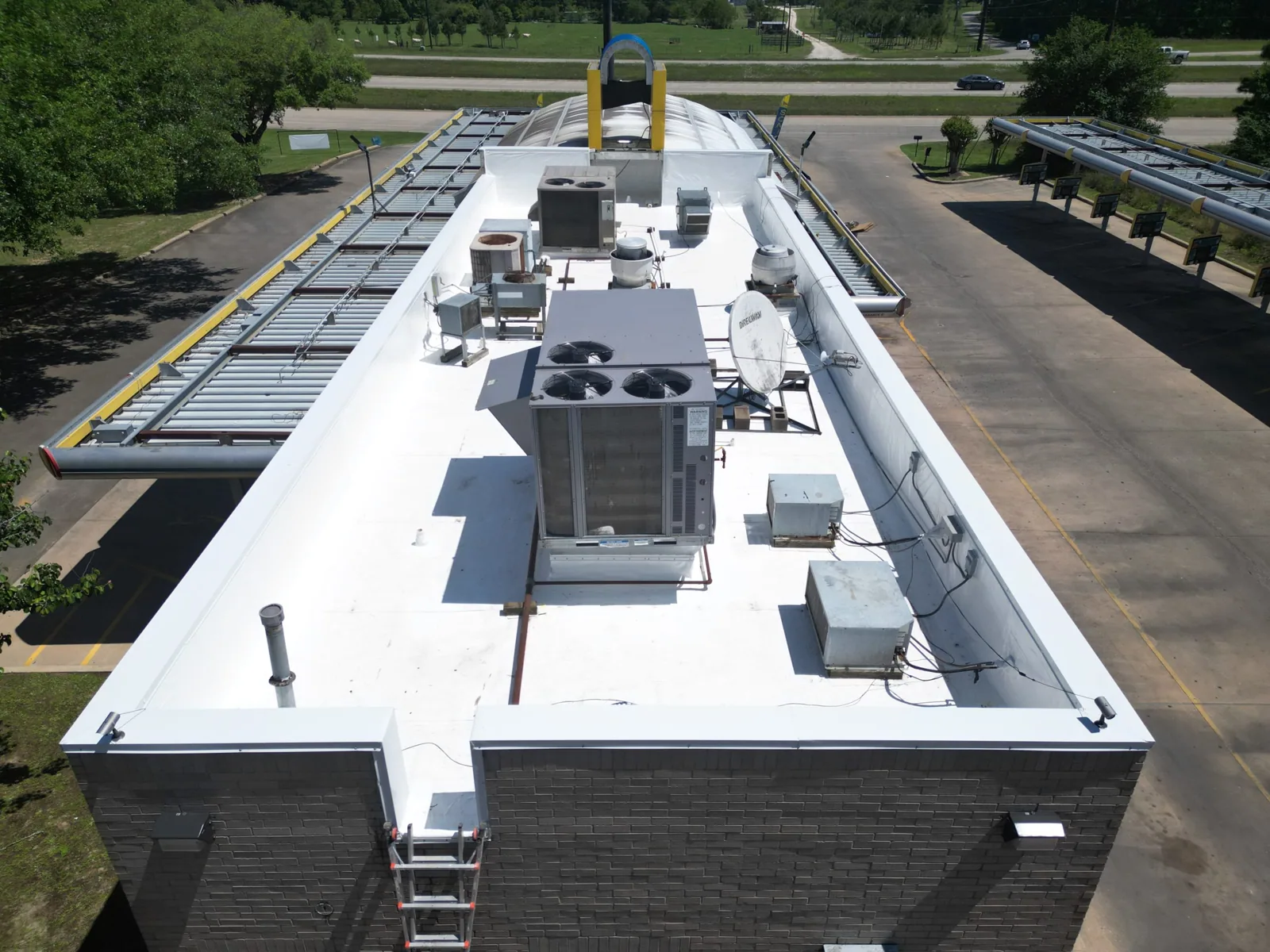
The seams on a Duro-Last roof are mostly made in a factory, so the first question is where the few field seams and custom flashings sit. Duro-Last supplies prefabricated PVC membrane, cut and welded to the dimensions of the roof before it ships, then installed in large sheets with welded flashings at curbs and pipes. That changes where a leak is likely to start. We trace the water to the field-welded seams, the perimeter attachment and the prefabricated boots, then record which roof section is involved. In Grand Prairie, TX, hot summers and spring storm exposure put steady demands on exactly those transitions.
First observation: the factory sheet and its field joints
A prefabricated sheet spans much of a roof section in one piece, with the factory welds already done. The field joints are where installers joined one sheet to the next and finished the edges. We probe those joints with a rounded tool, looking for lifted edges, skipped weld lengths and dirt trapped in the lap.
Prefabricated flashings sit over pipes, drains and curbs, so a changed penetration can leave a gap. If a mechanical unit was moved or a new conduit run was added after installation, the original boot may no longer fit. We note each change and decide whether a prefabricated replacement piece, a field-built flashing or a welded patch makes the more reliable repair. The roof sketch shows every spot we found, with a number beside each so the repair list and the photographs line up.
Perimeter attachment gets its own pass. The sheet is secured at the edges with fasteners and termination metal, and wind works at those points first. The City describes broad warehouse and manufacturing uses in the Great Southwest Industrial District, and a building with a long open perimeter there gives wind a lot of edge to work on, so we check coping joints, drip edges and fastener spacing along every wall.
Measurements: why the roof plan has to be exact
Because the sheets are cut to measure, a replacement or a section addition starts with accurate dimensions. We record the roof outline, parapet heights, curb sizes, drain locations and penetration positions, and we compare them with any existing drawings. Mistakes in those numbers show up at installation as short sheets or flashings that do not fit.
On a PVC roof that was installed years ago, a roof can gain units, conduits and vents over the years. We measure the roof as it stands today, not as the drawing remembers it. That keeps a re-roof or section replacement from being planned around features that have changed.
Recover: using the existing roof as the base
Prefabricated PVC is often used as a recover system, laid over an existing roof once the layers below are checked. The benefit is less tear-off, less debris and shorter exposure of the building. The condition is that the existing insulation and deck must be dry and sound. Wet insulation under a new sheet will keep a problem alive.
Our recover and overlay review starts with moisture mapping and a few test cuts. We check the fastener pattern, the existing membrane's attachment and the load the deck can take. If any one of those fails, the cleaner answer is tear-off of that section. The report shows the readings, so the owner sees why we recommended what we did.
Edge height is a recover detail people forget. A new sheet adds thickness, so drains, scuppers and curb flashings may need to be raised, and door thresholds must still shed water. We list each of those adjustments in the scope before the price is final.
Logistics: rolled sheets, staging, and warehouses
Large prefabricated sheets are delivered rolled or folded and lifted to the roof by crane or hoist. That makes staging a real planning item. The City says Grand Prairie's air, highway and rail access continues to draw warehouse, distribution and manufacturing construction, and an April 2026 development update announced a fulfillment center in the city, which adds another logistics building to the local roof mix.
On a warehouse roof near the I-20 corridor, we map crane position, lift path, truck routes and dock hours before the sheets arrive. Wind affects large sheets, so we set a speed limit for lifting and keep sandbags and temporary ties ready for any opened area.
Heat and weather: what the welds have to survive
Averaged over the years, DFW July and August highs sit near 96°F, and about twenty days reach 100°F or more. Heat expands PVC sheets, and the perimeter, the corners and the field joints take the strain. Regular inspection catches lifted edges before wind and rain find them.
Spring is the Metroplex's peak for severe weather, with hail and damaging wind possible somewhere nearly every year. We inspect after a significant storm for punctures, displaced edge metal and torn flashings, and we repair confirmed damage with welded patches. A storm report alone does not tell us whether the building was affected, so the walk decides.
Cleaning belongs in the maintenance plan. Dirt on a white PVC surface dulls reflectivity and can hide a lifted edge, so a periodic wash and a seam walk together cost little and keep the record current.
Options: patch, re-weld, or replace the section
Isolated seam and flashing failures fit welded repairs. A sheet that has shrunk away from the perimeter or cracked at a fold may call for a new section. Wet insulation widens the scope to tear-off. Price follows area, insulation, penetration count, crane access and schedule.
Comparison with other membrane makers is straightforward: Soprema offers modified bitumen and flashing resins, while Holcim Elevate offers single-ply sheets installed on site. We price each against the same roof section so the owner can compare scope, detail count and timing.
After any repair, a short follow-up walk confirms that the welds hold and the water leaves the roof as intended. The closeout file lists the sections touched, the products used, the measurements taken and the photographs, which gives the next manager a place to start.
Commercial Roofing Questions
Where do leaks usually start on a prefabricated PVC roof?
Most start at field joints, perimeter edges and flashings that were added or altered after installation. The factory seams are less often the cause. We probe each of those areas and mark open sections on the roof sketch before choosing a repair.
Can a Duro-Last roof be extended after new equipment is added?
In many cases it can, using custom-cut pieces and welded flashings. The new piece must bond to the existing sheet, so we test compatibility and clean the weld area. We record each addition so the roof drawing stays accurate.
Why does the roof need to be measured again before replacement?
Rooftop equipment, drains and parapet details change over time, and prefabricated sheets are cut to fit. Fresh measurements prevent short sheets and ill-fitting flashings at installation. We compare them with older drawings and flag differences.
What happens if insulation under a recover is wet?
A new sheet would cover the wet area but not fix it, and moisture can spread. We map the wet zones first and remove only what needs to come out. The rest of the roof can then take the new sheet over a dry base.
How do you protect a warehouse during sheet lifts?
Truck lanes stay clear, lifts are scheduled around dock activity and barriers go around the crane zone. We brief the property manager on the day's plan and adjust if loads change. Open roof areas are closed before the crew leaves.
Send the Duro-Last roof section for review
Share the roof area, active leak status, any changes since installation, and the access window. We will inspect the field joints and flashings and return a written scope for repair or replacement.
Call 555-555-5555 or request a roof assessment.