
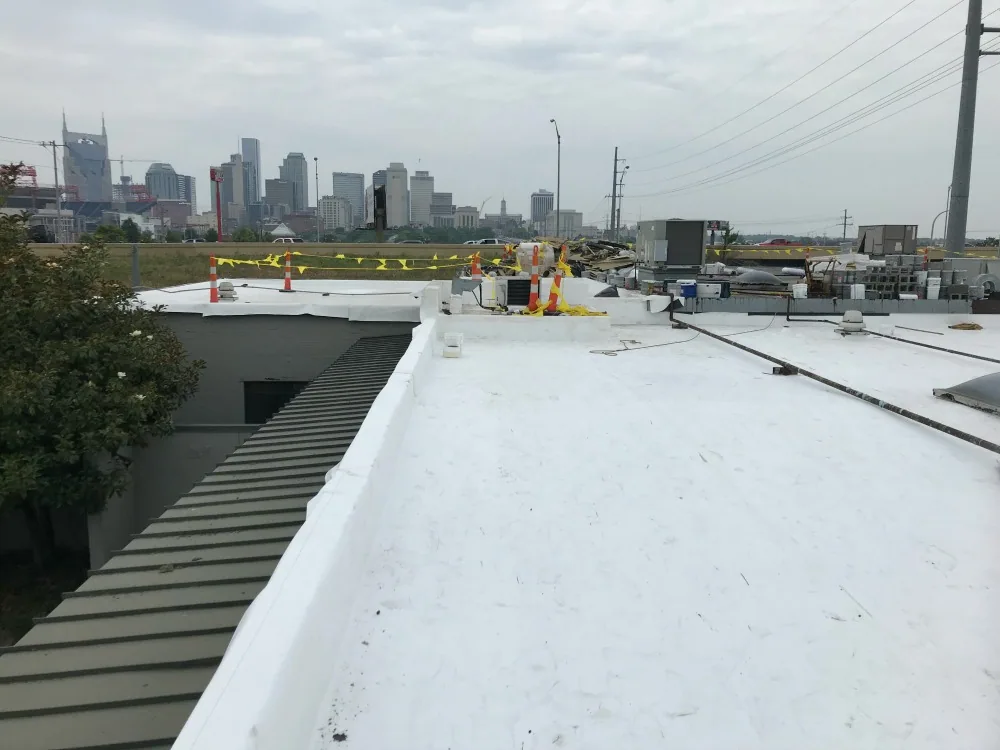
Black EPDM and white TPO can sit under the same Carlisle name, and each one asks different questions of a roof. Carlisle SynTec makes Sure-Seal EPDM and Sure-Weld TPO, along with other single-ply products, so the label alone does not tell us how a leak will behave. Our first observation is membrane type, then how it is held down, then where the seams and flashings have moved. Grand Prairie, TX summers keep daytime highs in the 90s, with roughly twenty 100°F days a year, so these details never get a rest. We separate a localized repair from a failing assembly before anyone prices a larger scope, and we write the finding down so the owner has something concrete to act.
First observation: EPDM, TPO, or something else
EPDM is a rubber sheet whose seams are joined with tape or adhesive, and it tends to fail at splices, corners and flashing terminations. TPO is a thermoplastic sheet whose seams are heat-welded, so the common failures are weld voids, cracked corner flashings and surface wear. Both can be reliable when the details are sound, and both can leak at a single bad detail while the field of the roof looks fine.
We identify the membrane by thickness, surface and seam construction, then compare it with any documents the owner holds. The City calls I-30 a business and entertainment corridor, and a retail or hospitality building along the I-30 corridor that was re-roofed in stages can carry different products on different sections. We label each roof section on the drawing and treat it as its own case.
Attachment: adhered, fastened, or ballasted
How a Carlisle membrane is held to the building changes what a repair involves. Fully adhered sheets rely on bonding adhesive and a clean substrate, so a repair must reach the same substrate cleanly. Mechanically attached sheets rely on fasteners and plates in the seam area, so wind flutter and loose plates are the usual concerns. Ballasted roofs rely on stone weight, which has to be moved before anyone can see the membrane.
Each method asks for a different access plan. Ballast has to be stockpiled somewhere safe for the deck. Adhered systems need dry surfaces and moderate temperatures for the adhesive to set. Mechanically attached systems need a pull test on a few fasteners. We choose the test that fits the system and record the result, so a later repair does not depend on guesswork.
Seams and splices: where the system opens first
A seam probe tells more than a glance. We run a rounded tool along welds and splices, looking for open edges, fishmouths, soft spots and a membrane that has pulled away from a lap. Around penetrations we check the pipe boot, pitch pan or curb flashing, because the pocket that holds sealant often cracks before the sheet does.
Where a seam has opened, the repair depends on what is under it. Dry insulation allows a contained patch with a cleaned and primed surface. Wet insulation means the water path has already reached the assembly, and the patch would only hide the problem. Moisture scans, infrared if the building allows it, and a few test cuts show how far the wet area reaches. We record the boundary before cutting out anything.
Heat and UV: what a Texas summer does to the details
Solar exposure ages every membrane, but the details show it first. Pipe boots lose flexibility, sealant lines shrink away from metal, and corner flashings tighten across the heat cycle. White TPO reflects much of the sun yet still expands and contracts across a hot day. Black EPDM absorbs more heat, which suits a cold climate better than a hot one but still performs when the splices are sound.
Spring storms bring hail and damaging wind to the Metroplex nearly every year, though any one site may escape them. After a storm we check coping, edge metal and fastener plates for movement, and we look at the membrane for punctures or bruising. Seasonal inspections before and after the hot months catch most of what the heat has started, which is the purpose of scheduled maintenance visits.
Sequence: opening the roof in controlled sections
On an occupied building, we open only as much roof as we can dry in during the same shift. A distribution or warehouse owner in the Great Southwest Industrial District may have dock traffic, rooftop units and conveyor ceilings right below the work, so crane location, material staging and fire-watch plans are agreed ahead of time. For a single-ply system the sequence runs from tear-off, to deck repair, to insulation, to membrane, to flashing, to inspection.
Carlisle's family of systems also includes fleece-backed membranes that bond to a cold-applied adhesive, which suits buildings where torches and hot asphalt are not welcome. We consider that option when the access plan makes open flame impractical. A related single-ply line such as Versico deserves the same membrane-by-membrane check, as do GAF commercial systems when a building carries a mix.
Records: what the closeout file holds
The closeout file includes dated photos, the roof map with every repair marked, the product and lot information for materials we installed, moisture readings, and the access conditions on the day. A manufacturer, an insurer or the next facility manager can all read the same record. Buildings permitted under the 2021 IBC family that the city lists for commercial work may also need permit or inspection paperwork, and we confirm that scope with the city before work starts.
The record also names what we did not touch. If a neighboring roof section is sound, the file says so and shows the photo, which keeps a later repair from reopening it. When the owner plans a capital budget, that map tells them which sections need attention this year and which can wait for the next scheduled walk.
Commercial Roofing Questions
Can an old EPDM roof be repaired, or is it time for a new membrane?
Repair holds when the sheet is still pliable and the splices can be cleaned and re-bonded. We test a few seams and a flashing corner. If the surface is cracked, shrunken or wet beneath, we show those results and compare a section replacement with a full one.
How do you tell whether a TPO weld is failing or just dirty?
Clean the area, then probe the edge. A sound weld resists the probe and shows a bonded line, while a failing weld lifts or peels. Dirt hides these conditions, so we wash first and then test. We record each open seam by location so the repair crew can find it.
What access does a Carlisle ballasted roof need?
Ballast must move before the membrane can be inspected, and the deck has to carry the weight where the stone is stacked. We agree on a stockpile spot with the property manager, set the order of removal, and replace stone only after repairs are complete and photographed.
Will a hailstorm in the Metroplex mean my Carlisle roof is damaged?
Not automatically. Large hail is an annual possibility somewhere in the region, while a particular building may see none. We inspect for confirmed impacts, document them with photos, and give the insurer only the sections that show damage.
What information should I gather before requesting a Carlisle roof inspection?
Find the roof area, any prior repair invoices, the leak locations and the hours when the building can be accessed. If a warranty file exists, send it. We can start with a walk and a membrane sample even when paperwork is missing.
Send the Carlisle roof for a first check
Share the roof area, active leak status, membrane type if known, and the access window. We will inspect the seams and flashings and give you a written scope that separates repair from broader replacement.
Call 555-555-5555 or request a roof assessment.