
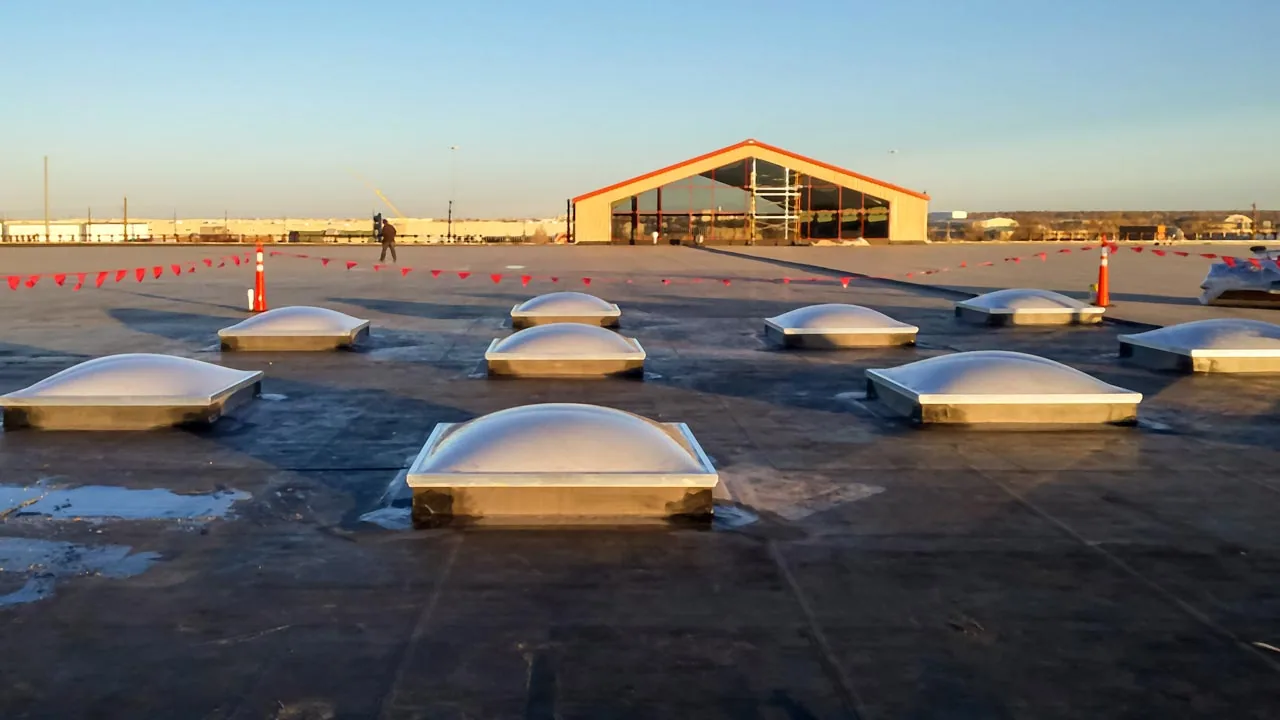
A ceiling stain below a skylight does not identify which roof transition has failed. In Grand Prairie, TX, we locate the corresponding roof section and inspect the skylight curb, perimeter flashing, fasteners and nearby membrane seams. The first check follows the water path without stepping on a translucent panel. We document the curb condition, nearby penetrations and interior report, then decide whether a localized flashing repair is supported. A distribution building in the Great Southwest Industrial District may have long roof travel routes and active loading below; the inspection plan must account for safe access and the actual assembly.
Curb transition: inspect the full perimeter
We check each side of a skylight curb, including corners, counterflashing, membrane termination and the curb-to-roof connection. A sealant bead that looks intact from the hatch may be separated at a corner or cover an incompatible repair. We look for open laps, loose fasteners, deterioration at the curb, and signs that water travels beneath the flashing. If the skylight frame or panel is damaged, that condition is separated from the roof membrane scope.
DFW's hot summers expose roof details to repeated solar heating and cooling. Regional climate normals show July and August average highs in the mid-nineties, with some days above 100 degrees. That context informs inspection timing and material handling, while the curb itself determines repair. We note the surface condition and any movement or split that is visible. A commercial roof inspection can trace adjacent transitions if the interior report does not align with one curb alone.
Penetration group: compare nearby details
Skylights often sit near vents, pipes, equipment curbs or conduit supports. Each penetration uses a flashing detail suited to its shape and the roof assembly. We inspect those details separately and look for a shared water path, such as a seam above several penetrations or a drain route crossing the area. This prevents a repair at one curb from leaving an adjacent opening unreviewed. An infrared moisture survey may help map concealed wet areas when surface findings do not explain the interior report.
In Grand Prairie's industrial and business districts, equipment layouts can vary from one roof section to another. The Great Southwest Industrial District includes warehouse, distribution and manufacturing uses, but those uses do not establish which equipment or skylights a building has. We inventory the actual penetrations during inspection. If hail is reported, we photograph the panel and curb condition without assuming that a regional weather event caused a specific defect. A hail damage review can distinguish visible marks from confirmed membrane or flashing damage.
Repair detail: restore compatible flashing
The repair method depends on the membrane, curb material and condition of the substrate. We remove failed flashing as needed, prepare stable material, and tie the new detail into the roof surface. Corners receive particular attention because layers must remain continuous around the curb. A simple bead over a loose membrane edge is not treated as a completed repair. If the substrate is wet or the curb has deteriorated, that finding changes the scope and may require further work before the flashing can be closed.
On a thermoplastic system, the patch and flashing components must be suitable for the installed membrane and welded correctly. A different system may need another method. We identify the assembly before selecting materials, then record the boundary and closeout check. The detail can be coordinated with TPO seam work or a broader commercial repair scope when nearby conditions also need correction. The proposal distinguishes curb work from any skylight replacement or glazing scope performed by another trade.
Access route: protect occupants and roof openings
Skylight panels can be fragile and must not be used as walking surfaces. We identify roof access, fall-protection needs, marked openings and a clear path to the curb before starting. Interior protection may be required beneath an active leak or a work zone. For an occupied warehouse, the route can be coordinated around loading and stored goods. A commercial office or retail property may need a tenant notice or a restricted area below the work.
Spring is the regional peak for severe weather in the Metroplex, so repair scheduling may need a weather hold. We keep only a manageable section open and protect it if conditions change. The building contact confirms any skylight that serves daylight-sensitive operations or must remain unobstructed. Along the I-30 corridor, the property's access pattern may differ from an industrial roof. If water entry is active, our around-the-clock crews can respond on weekends and holidays to protect the area while the permanent curb or penetration detail is evaluated. Work near an outlet can include a review of the drainage route where it intersects the affected section.
Closeout check: record each opening
We photograph the completed curb, corners, membrane tie-in and nearby penetrations, then note any item excluded from the repair. If a controlled water test is appropriate and safe, the tested area and result are recorded. The closeout also identifies whether the skylight panel or frame needs a separate trade review. That distinction lets the owner track roof flashing and glazing without combining two different repair boundaries.
Share the building location, approximate skylight or penetration area, active leak status, roof assembly and access window. Interior photos can help us find the right roof zone, while the roof inspection confirms the detail. We can document which openings were examined, what materials were repaired and what condition should be monitored. That record helps the next maintenance visit return to the same curb and compare its corners, seams and surrounding drainage path.
Commercial Roofing Questions
Can a skylight panel be walked on during inspection?
No. We treat skylight panels as fragile openings and plan a safe route that stays on designated roof surfaces. Access, fall protection and opening marking are confirmed before the inspection. If the curb cannot be approached safely, we record the limitation and arrange a suitable method rather than placing weight on the panel.
Why can water appear far from a leaking skylight curb?
Water can travel beneath the membrane or along a seam before reaching the ceiling. We compare the interior location with roof slopes, seams, penetrations and the curb perimeter, then test the likely transition. The report explains which paths were checked and what remains unconfirmed. A stain alone is not used to select a flashing repair.
Does a skylight leak always require panel replacement?
The curb flashing, frame and glazing are evaluated as separate parts. If the panel is intact and the roof transition is the source, a flashing repair may address the condition. A damaged frame or glazing may require another scope or trade. We document what the roof inspection shows before recommending either replacement or localized repair.
How are several nearby roof openings inspected?
We map each curb, pipe and equipment penetration, then compare their details and nearby seams. If several openings share a roof section, the inspection can include a moisture survey when appropriate. Each opening is recorded separately so the repair plan identifies which transition is affected and which one remains intact.
Can skylight flashing work happen while a building operates?
The work can be phased around building activity when access and protection are planned. We identify the route to the roof, the area below the curb, tenant or loading conflicts, and any active interior leak. The contact can schedule a controlled window and keep the work zone separate from occupied operations. Weather may change the sequence if the roof must be secured.
Inspect a skylight or roof penetration
Send the building location, affected opening, active leak status, roof assembly and access window. We will trace the water path, inspect the curb or penetration flashing, and document the repair boundary and any separate glazing condition.
Call 555-555-5555 or request a roof assessment.